Showing posts with label Bermondsey. Show all posts

Monday, 12 August 2019

Peruvian Textiles at the Fashion and Textile Museum

Peru has a strong national identity in its fibres and textiles and the Fashion and Textile Museum in Bermondsey, London has a rather fabulous exhibition on which showcases some of these items. The exhibition is rather aptly called Weavers Of The Clouds.


When the Spanish colonised Peru, they brought a general dress code to the style of dressing to the indigenous communities. It incorporated a mix of established traditional of weaving with contemporary methods and new textiles were created. The traditional techniques were valued, but the Spanish textiles offered innovative ideas, along with the introduction of sheep wool and cotton.


The skirts, known as pollers, are highly decorated with embroidery and are bordered with a woven trim.


A full costume consists of many garments, each with its own unique embellishment or decorative motif.


The traditional costumes of Peru show a diverse range of skills and each individual garment can feature a variety of techniques. The style of a garment identifies each community or region and can also indicate a person's marital status, occupation and economic status.


Many of the garments are decorated with these stunning giant metal brooches which also hold garments together.


The exhibition celebrates the diversity of applied arts created in a wide range of materials, encompassing numerous symbols and employing various techniques.


Contemporary Peruvian fashion designers have looked at their own culture for inspiration and the upstairs section of the exhibition shows work from designers who work with indigenous people, using traditional skills.


My favourite piece was this ensemble by Meche Correa who used a wide border along the bottom of the dress using a brightly coloured Andean floral motif.


The dress has been accessorised with a purple and green clutch bag and bright red hat.


This wonderful exhibition closes on 8th September, so not long left to get there and check it out!


Friday, 16 November 2018

Night and Day

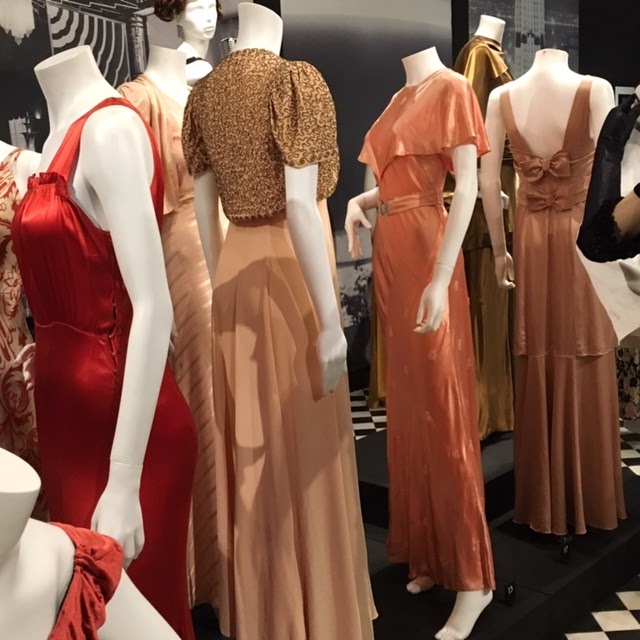
I recently had the pleasure of going to the Night and Day exhibition at the Fashion and Textile Museum in Bermondsey. The exhibition explores the day and evening styles of the 1930s and is complemented by photographs of the stars of that decade.


The 1930s was a period of social change, seeing the end of the excesses of the Jazz Age of the 1920s and seeing the beginning of World War II. These changes were echoed in the clothing of the decade, which was inspired by the Art Deco and Moderne styles, but also by the surrealism art movement as well as the sensuality of the silver screen sirens.


Living in the 1930s meant dealing with extremes, from the depths of poverty for many people, to dazzling parties for the wealthy. The glamour of the era was reflected in the evening wear.


The sleeves of the black crepe gown above drape beautifully and are covered in sequins, while the dress below uses sequinned clusters to create a shiny polka dot effect.


Dancing became a social pastime in the 1930s, inspired by the glamour of the Hollywood movies. Liquid satin and bias cuts helped to create fluidity and drama, with fitted waists and greater volume in the sleeves creating a sculpted effect that oozed glamour.


I was amazed by the fineness of the silks on show and the ability to create such technical gowns with such a difficult fabric to work with, yet with the outcome of sheer effortless beauty.


The dresses were very feminine and the red dress above has pretty frill details that float when you move.


I love the flesh and peach tones of the era. You can see how the bias cut works on the dress below (right) as well as the decliacy of the detail in the criss-crossing straps on the neckline.


As film stars became key fashion influencers, Hollywood costume designers took influence from Parisian design, and Paris designers created fashions inspired by Hollywood, with exaggerated detail.


This heavily embellished jade evening coat is embroidered with white beads and shells in the Rococo revival fashion of the late 30s and was designed by Norman Hartnell.


The 1930s saw the growth of mass manufacture and cheaper ready-to-wear fashion. Printed dress fabrics made of rayon became very popular, having the practical advantage of being cheaper than embroidered fabrics and less likely to show stains.


The brown, pink and yellow leaf print dress below has a pretty cowl neck and long narrow sleeves.


The brown and yellow circle print below has yellow edging at the neckline. The addition of a belt adds a pretty detail to the dress and cinches in the waist.


Home dressmaking was very popular in the 30s and the yellow floral dress below was most probably hand made. The collar has a decorative crocheted edge.


Going abroad was too expensive for most people and by the mid 30s seaside resorts within the UK were popular, with colourful advertisements in newspapers and brochures to lure people in. My favourite outfit in this section of the exhibition was the coat and bathing suit below, which features an abstract marine print by Crysede, a Cornish fabric printing company. The bathing suit is made of wool but uses Lastex, which revolutionised the fit of swimwear.


I also love the stylish outfit below which consists of white cropped trousers with a fabulous red spot handkerchief halter top. Casual trousers became a favourite with active women in the 1930s.


Although this exhibition is small, it is filled with beautiful gems from the 1930s and is a joy to visit.

 The Fashion and Textile Museum is the only museum in the UK solely dedicated to showcasing developments in contemporary fashion as well as providing inspiration, support and training for those working in the industry and was founded by Zandra Rhodes in 2003.


Friday, 15 June 2018

Orla Kiely

As a textile designer myself, I'm always interested to see how other textile designers choose to work. Many, like me, freelance for wholesalers, retailers or work for an agent who sells their designs for them, but every now and then you get a textile designer who makes a name for themselves and recognition for the beautiful designs they do. One of those people is Orla Kiely, who is well known for her graphic patterns which are instantly recognisable. She now has an exhibition of her work on at the Fashion and Textile Museum and I headed down there to check it out.


The exhibition features over 150 patterns and products as well as collaborations with photographers, film directors and architects. You quickly get a feel for how much she has done over the years that she has been designing. The walls were covered with a random patchwork of all the designs she has done, many of which I'd forgotten about.


Her well known 'Stem' design (similar to the one above) has been used on everything from handbags to oven gloves and has been reproduced in a varying style and colour but always manages to keep the essence of the simple leaf and stem design that is instantly recognisable.


The designs above appear simple but have obviously been well thought out using a balanced colour palette and a variety of scales within each design to give it interest. For example, the design above (bottom left) uses a very simple black and red floral and leaf motif, but by alternately enlarging the flower, it creates more interest within the design.


The designs above are fun and playful and I love the abstract nature of them. Look closer at the green design and you see that it is a selection of little people tipping their hats to one another. The simple yet clever design below shows swimming ladies. I love the Art Deco feel to the design.


Orla Kiely has used a lot of animal motifs in her designs. In a lot of cases their simple, set layout creates a new design where the negative space is just as important as the positive. I like the simple inclusion of a selection of colours in each of the foxes faces below.


Orla Kiely was always interested in fashion from an early age and the styling of her fashion ranges were often inspired by the 60s and 70s, as were her textile designs. For this exhibition she created garments that showed a play on scale.


She created nine enormous garments based on previous collections in iconic prints (above), and alongside those she had the most beautiful little dolls wearing the same print but scaled right down (below).


Upstairs in the exhibition there is a selection of garments from past collections. One of my favourites was this dress that had a fab graphic print of a 1960s shoe. The model was also wearing similar shoes.


And last, but definitely not least, there was a wall of handbags! Heaven. They had all been organised in order of colour and nearly made me weep with joy!


In the mid-90s, whilst showcasing hats at London Fashion Week, Orla Kiely's father noticed that few women actually wore hats, but they all had a bag, and so began a key addition to the Orla Kiely collections. She started with cotton bags, but soon moved on to more durable versions, often including a quirky touch. My favourite bag was the one below.


Popular Posts