Showing posts with label London museum. Show all posts

Tuesday, 3 December 2019

Zandra Rhodes - 50 Years of Fabulous

Zandra Rhodes' fashion career has survived for 50 years and she is one of the few fashion designers who also creates all her own textile prints. She has kept to her distinctive style throughout her career and the Fashion and Textile Museum now has an exhibition, showcasing her work from the very beginning. I went down there on Friday to check it out and really enjoyed it. The exhibition space is small, but they have packed it with an eclectic mix of garments, with at least one garment from each year of her career.


Zandra's own look matches her fashion style, with her bright pink hair and dramatic makeup.
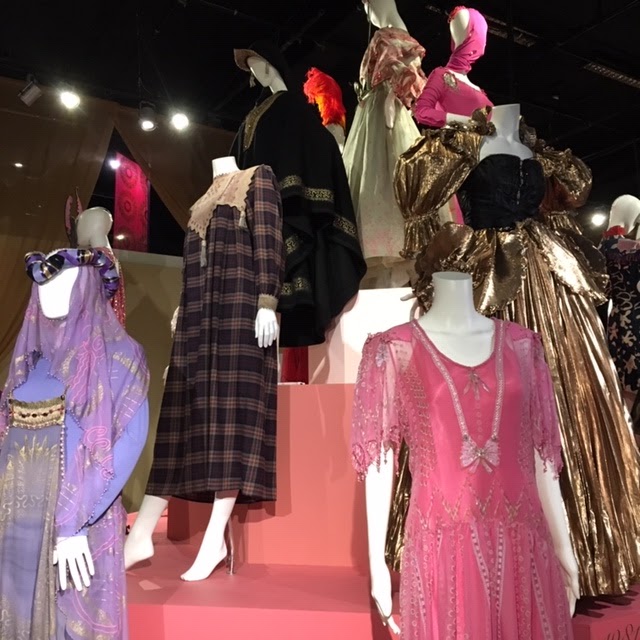

Seeing the garments displayed like this shows the many styles, eras and cultures that Zandra was inspired by. Just in this photo, you can see Indian influences and 1930s influences.


This pink silk chiffon dress is hand-beaded and comes from the 'Fairy' collection. The dress has been screen printed with buttons and bows and a troupe l'oeil bow decoration. The collection was inspired by the Flower Fairy illustrations of Cicely Mary Barker.


This pretty padded evening jacket is from the 'Shell' collection where the shape of the jacket was dictated by the shape of the print. The base of the jacket is gathered into a padded quilted pink border.


This silk chiffon evening dress is from Zandra's Mexican collections. The deep V-neckline is edged with a pleated and frilled collar and is held closed with lacing and enamelled flower beads. The full length of the skirt is printed with a Mexican banana leaf pattern.


Most of Zandra's designs are bright and colourful, but this stunning dress is all black and includes an embellishment of peacock feathers carefully placed on very sheer black chiffon.


This short satin purple dress was digitally printed with her 'Jungle Trail' print. Rhodes is known for her hand screen-printed designs, but has also explored new processes and techniques, enjoying the challenges involved.


This dress is printed with her 'Giant Fantastic Flowers' print. The neckline is a circle shape that has been created by cutting out the centre of one of the flower motifs. The dress was created in 1988 but uses a 1960s sensibility. Flowers are a recurring motif in Rhodes's work and they are always bold and bright, often inspired by the artist Henri Matisse.


This raw silk mini dress is from the 1991 'Flower Power' collection and is embellished with decorative stitching and appliqué flowers, made from ribbon, rope and wooden beads.


The upstairs area of the exhibition had a wonderful selection of Rhodes's hanging prints. I especially loved this chiffon pink piece.


One of the keys to Zandra's designs is her knowledge of the processes of printing and designing and she makes it all look effortless, even though each garment is carefully thought out and takes months of planning. Above you can see her at work in her studio. Once the design has been decided, it is painted onto a frosted acetate film, called a kodatrace - below.


That design is then exposed onto silk screens (below) - one screen for each colour.


The design is first tested on paper to make sure the design registers and that the screen works well.


It was great to be able to look up close and see her annotations.


Below is the finished item printed onto a stunning pink chiffon panel.


The finished garment is stunning, using a pink print for the bodice.


The skirt of the dress is cut in layers and uses the shape of the curved print to create the curve of the design of the dress with a resulting ethereal feel.


Up close you can see beading and embellishment that has been added.


This lovely exhibition is on at the Fashion and Textile Museum until 26th January 2020.

Monday, 10 June 2019

Yinka Shonibare at Tate Modern

A visit to the Tate Modern on Friday morning was a welcome break from the rain and a great way to get inspired. I decided to wander around the permanent exhibitions and came across a room with a stunning installation by British-Nigerian artist Yinka Shonibare. He was born, studied and lives in London, but grew up in Lagos, Nigeria and his dual identity as British-Nigerian has been the starting point for much of his work.
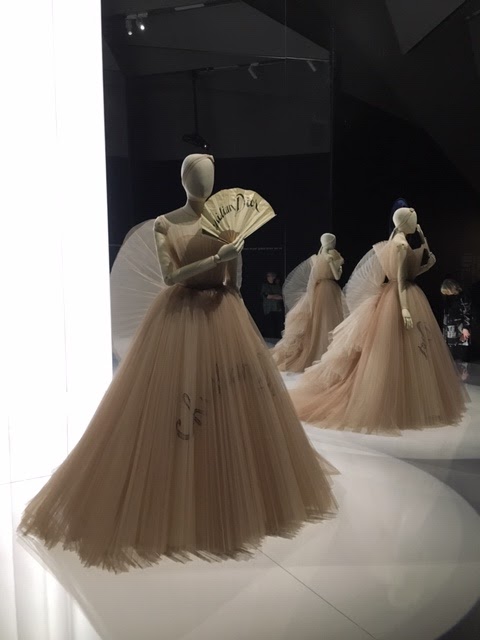

This piece of work is called The British Library and contains more than 6,000 books, each covered in the brightly-coloured fabric synonymous with West and Central Africa.


2,700 of the books have gold printed names on them. They are the names of first and second-generation immigrants to Britain who have made significant contributions to British culture and history. There are also names who opposed immigration.


The remaining unmarked books suggest that the story of immigration in Britain is still being written.


Sunday, 7 April 2019

Pierre Bonnard - The Colour of Memory

The Tate Modern is currently holding an exhibition of the work of Pierre Bonnard and I headed down there a few weeks ago to check it out. The exhibiton focuses mainly on his mature work where he had developed a highly individual command of colour. He used that colour to paint sensuous images of everyday life. As a textile designer, it was very inspiring to see his use of colour up close and the unconventional use of contrasting hues. One of the best examples of colour use is this scene below which uses a bold purple shade to convey the light on the table top.


Bonnard also painted everyday scenes like the 'Woman at a Table' below, which were snippets of life. The composition is also more unconventional, and more like a snapshot in its set up. The viewpoint makes us feel like we are sharing the meal with the woman, who is up so close that her head is cropped. I love the vibrancy of the red dress and rosiness of the cheeks.


In 'The White Tablecloth' below, the simplicity of the cloth sets off the items that are placed on it and surrounding it. I zoomed in on the richly coloured garment of the woman standing.


Bonnard created many room scenes, which used unconventional angles and viewpoints. I love the use of colour in the painting below which combines rigid angles of the interior (along with a fab yellow patterned wallpaper) with the softness of the landscape through the window.


The painting below, has a still life in the foreground and then you notice the woman standing with her back to us in the background, as if she is just about to leave the room.


Bonnard worked on many nude paintings and liked to use mirrors to challenge the idea of space and time. In the painting below he shows two different angles of the pose - the nude in the foreground and her reflection in the mirror, where the suggestion of an outstretched arm is shown.


In 'The Mantelpiece' below, Bonnard creates a complex visual structure with a stretching woman reflected in the mirror and a painted nude on the wall behind her. The nude stands where the painter would be, but the painter does not appear in the reflection.


The 'Nude Crouching in the Tub' below relates to a specific photograph that Bonnard took. The relaxed pose was captured on film and then recreated in painted form. Bonnard used photography and its spontaneous composition as an influence on his paintings and soon no longer relied on a camera to create these poses.


The warm tones of the painting below appealed to me. The orange of the floor reflects the light of the  late afternoon sun coming through the window.


Bonnard's paintings of the bathing nude introduced a new element to his paintings and showed how different the body looks under water. The painting below is the first of four paintings addressing this theme. In this painting, the nude stretches across the width of the canvas and the composition can be divided into a series of horizontal bands - the tiled wall, the white bath, the immersed body, and the rim and the floor.


This later version of a nude in the bath (below) is much moodier, with a more intense and expressive use of colour. Marthe de Meligny was his lover and model. Her health started deteriorating and she would take baths every day following water treatment for her ailments. Bonnard captures the intimacy and melancholy of their relationship through this painting. I love the use of purples, blue and mustard yellow to create the heaviness of the emotions.


This wonderful exhibition is on at Tate Modern until 6th May 2019.


Friday, 22 February 2019

Delicious Dior

I had the great pleasure of going to the highly anticipated Dior exhibition at the Victoria and Albert museum last week. The V&A has become well known for its impressive temporary exhibitions and I knew this one was going to be good!


Dior's first collection was launched in February 1947 with the now iconic New Look which used a silhouette of full skirts and nipped in waists. This was seen as very extravagant at the time when rations on fabric were still in place. This was the outfit that opened the exhibition.


In 1991, when John Galliano was designing for Dior, he created the outfit below which echos the style of the New Look, with a modern twist.


Christian Dior's designs played with structure and proportion to create clothes that powerfully expressed an attitude. He carefully considered movement, with each garment needing careful construction and workmanship.


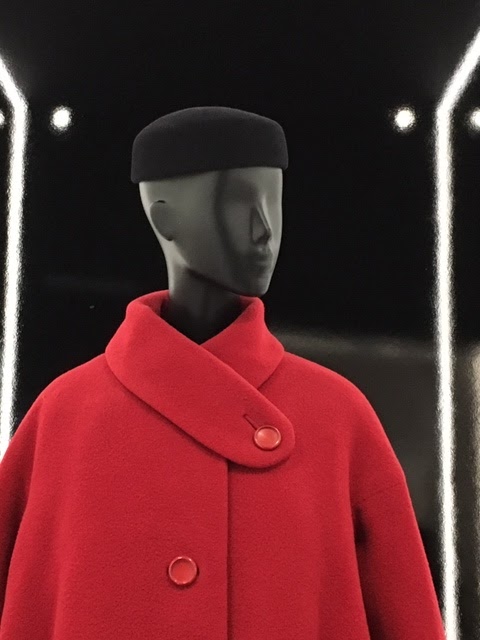
Continuity between collections along with headline-grabbing looks meant the sustainability of the fashion house. I love the simple drama of this stunning red coat.


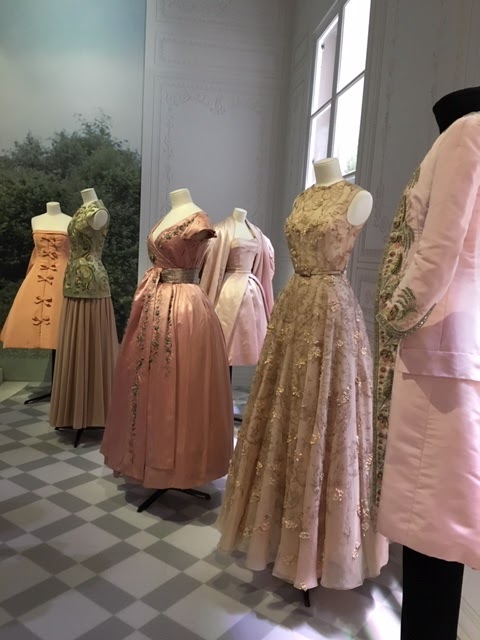
Dior often used historic references in his designs - the tight waists of the mid-19th century styles and the sumptuous silks of the 18th century. 


Many of the dresses created by Dior and his successors drew on the lavish style of the court dress worn at Versailles. The dress below, designed by Galliano uses gold thread, blue feathers and Swarovski crystals.


As a young man, Dior travelled a lot and from the launch of his first collection he took inspiration from the architecture, landscapes, art and textiles or different countries and cities.


This outfit was inspired by Egypt and uses pieces of turquoise leather to create a scale effect.


Asian countries also influenced Dior, from Japanese kimonos above, to Chinese silks below.


I love this stunning red coat designed by Raf Simons. The style is a nod to the full skirts and nipped in waist of the New Look and uses the colour red of the coat from his first collection. I love the inclusion of the ultra modern metal belt.


The outfit below uses a special technique to concertina the fabric of the skirt into tiny pleats.


The bow on the outfit below, designed by Gianfranco Ferre, is stunning. No need for bright colours as it speaks of itself.


The ateliers, or workrooms, are at the heart of Dior and it is where ideas are turned into exquisite haute couture designs. Once a design has been selected, it is taken to the atelier where a toile was made. This is a prototype garment and is usually made in white cotton fabric. This is when the fit and proportions etc are irned out in the toile garment before the real garment is made and this room in the Dior exhibition showed a number of toiles.


The toile below shows an intricately folded collar design with a hand drawn floral motif that has been pinned over the top to show where embroidery detailing would be used.


The purple garment below is the finished item.


The final room in the exhibition is called The Dior Ball and showcases what Dior does best - evening dresses. Throughout his career he enjoyed designing clothes to be worn at balls and fancy dress parties where he could indulge his imagination and show off the skills of the haute couture ateliers.


His extravagant creations combined skilful draping, intricate embroidery and stunning embellishment and he loved a bit of gold!


Dior's evening gowns often took finery and excess to the extreme.


Dior's successors have continued the excess that has become synonymous with the fashion house.


All these creations are housed in an ever-changing light show where day becomes night and opera and classical music set the scene.


The final creation in this show is an ethereal gown which sums up the style of Dior.


Popular Posts