Showing posts with label Fashion and Textile museum. Show all posts

Monday, 16 March 2020

Out of the Blue

Out of the Blue is an exhibition currently on at the Fashion and Textile Museum that is celebrating the work of Designers Guild, a design company founded in 1970 and still going strong today. It was founded by Tricia Guild who draws on colour, pattern, texture and form to create a harmonious space and her signature style is instantly recognisable for its vibrant colour palettes and painterly style.


The first room of the exhibition showcases beautiful hand painted birds and florals. Along with these is a selection of paint and paper mediums that were used to create the birds. It's great to see how important these traditional methods were, and are, still important to the company.


A voice-over by Tricia Guild talks about how the introduction of digital printing has been really useful for the business as it means that you can capture the nuances of colour and texture of hand painted work on the fabric without losing its quality. This is unlike using screen printed techniques where a limit of 18 screens means that you can't often incorporate many tones of colours.


The painted bird sketches were used as inspiration for this final scenic mural in beautiful shades of blue and greens with a hint of pink bird here and there. The colours of the mural tie in with the blue of the sofa and the teals of the velvet cushions.


Tricia Guild's love of nature has always played a large part in the look of the company.


The enormous florals of the 'Le Poeme de Fleurs' collection show how a change in scale and colour can make a radical difference to the final effect. There's a hand painted feel to each flower yet a modernity in the colour palette. Mixed with a mustard yellow vase and vintage rattan chair, the look becomes eclectic and fresh.


Tricia's love of Italy has influenced her designs over the years and she used the luxurious silks from Venice, silk brocades, flocked silk and cut velvet to create a new contemporary elegance in a vibrant colour story. Acid greens sit against hot pinks and vivid turquoise.


She also travelled to India regularly where she came across a plethora of fabrics and got to meet the skilled workers who made them. In the fabrics above she has captured the vibrance of Indian summers as well as the colours of the women's saris. She also used Indian printing techniques, such as block printing, creating a cushion with a gold motif on a luscious turquoise silk. The wallpaper (above right) captures the texture of an aged blue painted Indian wall.


Her style varies quite a bit throughout her career and this can be seen in the two room sets above. They both use shades of green and pink yet the collection on the left (Ornamental Garden) is much more traditional in style than the modernistic theme on on the right.


Plain and semi-plain fabrics have always been an important part of Designers Guild as these fabrics provide relief from the heavily patterned fabrics within a collection. Above, bright woven silks on the left sit amongst sumptuous jacquard velvets on the right.


The creative process can take up to 18 months from start to finish and Tricia Guild works closely with her design team, starting with mood boards and colour chips (above left) to the finished product (above right). As you can see from both images, the integrity of the initial design has been achieved amazingly well in the finished product.

This exhibition is on until 14th June 2020.


Tuesday, 3 December 2019

Zandra Rhodes - 50 Years of Fabulous

Zandra Rhodes' fashion career has survived for 50 years and she is one of the few fashion designers who also creates all her own textile prints. She has kept to her distinctive style throughout her career and the Fashion and Textile Museum now has an exhibition, showcasing her work from the very beginning. I went down there on Friday to check it out and really enjoyed it. The exhibition space is small, but they have packed it with an eclectic mix of garments, with at least one garment from each year of her career.


Zandra's own look matches her fashion style, with her bright pink hair and dramatic makeup.


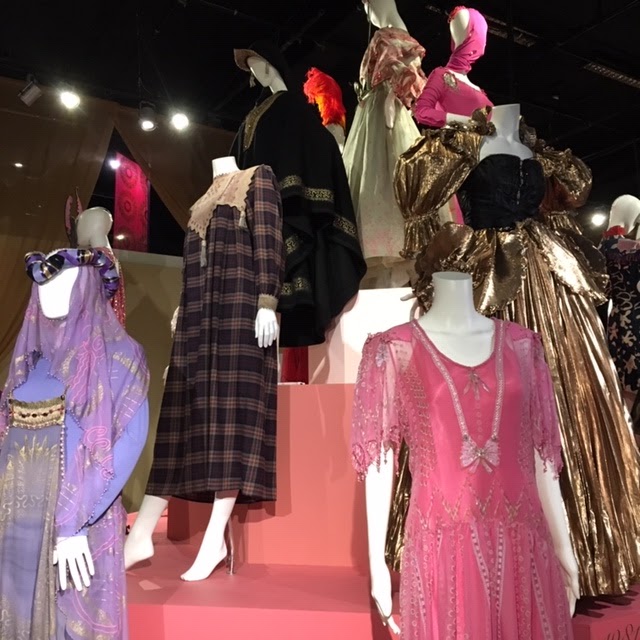
Seeing the garments displayed like this shows the many styles, eras and cultures that Zandra was inspired by. Just in this photo, you can see Indian influences and 1930s influences.


This pink silk chiffon dress is hand-beaded and comes from the 'Fairy' collection. The dress has been screen printed with buttons and bows and a troupe l'oeil bow decoration. The collection was inspired by the Flower Fairy illustrations of Cicely Mary Barker.


This pretty padded evening jacket is from the 'Shell' collection where the shape of the jacket was dictated by the shape of the print. The base of the jacket is gathered into a padded quilted pink border.


This silk chiffon evening dress is from Zandra's Mexican collections. The deep V-neckline is edged with a pleated and frilled collar and is held closed with lacing and enamelled flower beads. The full length of the skirt is printed with a Mexican banana leaf pattern.


Most of Zandra's designs are bright and colourful, but this stunning dress is all black and includes an embellishment of peacock feathers carefully placed on very sheer black chiffon.


This short satin purple dress was digitally printed with her 'Jungle Trail' print. Rhodes is known for her hand screen-printed designs, but has also explored new processes and techniques, enjoying the challenges involved.


This dress is printed with her 'Giant Fantastic Flowers' print. The neckline is a circle shape that has been created by cutting out the centre of one of the flower motifs. The dress was created in 1988 but uses a 1960s sensibility. Flowers are a recurring motif in Rhodes's work and they are always bold and bright, often inspired by the artist Henri Matisse.


This raw silk mini dress is from the 1991 'Flower Power' collection and is embellished with decorative stitching and appliqué flowers, made from ribbon, rope and wooden beads.


The upstairs area of the exhibition had a wonderful selection of Rhodes's hanging prints. I especially loved this chiffon pink piece.


One of the keys to Zandra's designs is her knowledge of the processes of printing and designing and she makes it all look effortless, even though each garment is carefully thought out and takes months of planning. Above you can see her at work in her studio. Once the design has been decided, it is painted onto a frosted acetate film, called a kodatrace - below.


That design is then exposed onto silk screens (below) - one screen for each colour.


The design is first tested on paper to make sure the design registers and that the screen works well.


It was great to be able to look up close and see her annotations.


Below is the finished item printed onto a stunning pink chiffon panel.


The finished garment is stunning, using a pink print for the bodice.


The skirt of the dress is cut in layers and uses the shape of the curved print to create the curve of the design of the dress with a resulting ethereal feel.


Up close you can see beading and embellishment that has been added.


This lovely exhibition is on at the Fashion and Textile Museum until 26th January 2020.

Monday, 12 August 2019

Peruvian Textiles at the Fashion and Textile Museum

Peru has a strong national identity in its fibres and textiles and the Fashion and Textile Museum in Bermondsey, London has a rather fabulous exhibition on which showcases some of these items. The exhibition is rather aptly called Weavers Of The Clouds.


When the Spanish colonised Peru, they brought a general dress code to the style of dressing to the indigenous communities. It incorporated a mix of established traditional of weaving with contemporary methods and new textiles were created. The traditional techniques were valued, but the Spanish textiles offered innovative ideas, along with the introduction of sheep wool and cotton.


The skirts, known as pollers, are highly decorated with embroidery and are bordered with a woven trim.


A full costume consists of many garments, each with its own unique embellishment or decorative motif.


The traditional costumes of Peru show a diverse range of skills and each individual garment can feature a variety of techniques. The style of a garment identifies each community or region and can also indicate a person's marital status, occupation and economic status.


Many of the garments are decorated with these stunning giant metal brooches which also hold garments together.


The exhibition celebrates the diversity of applied arts created in a wide range of materials, encompassing numerous symbols and employing various techniques.


Contemporary Peruvian fashion designers have looked at their own culture for inspiration and the upstairs section of the exhibition shows work from designers who work with indigenous people, using traditional skills.


My favourite piece was this ensemble by Meche Correa who used a wide border along the bottom of the dress using a brightly coloured Andean floral motif.


The dress has been accessorised with a purple and green clutch bag and bright red hat.


This wonderful exhibition closes on 8th September, so not long left to get there and check it out!


Friday, 15 June 2018

Orla Kiely

As a textile designer myself, I'm always interested to see how other textile designers choose to work. Many, like me, freelance for wholesalers, retailers or work for an agent who sells their designs for them, but every now and then you get a textile designer who makes a name for themselves and recognition for the beautiful designs they do. One of those people is Orla Kiely, who is well known for her graphic patterns which are instantly recognisable. She now has an exhibition of her work on at the Fashion and Textile Museum and I headed down there to check it out.


The exhibition features over 150 patterns and products as well as collaborations with photographers, film directors and architects. You quickly get a feel for how much she has done over the years that she has been designing. The walls were covered with a random patchwork of all the designs she has done, many of which I'd forgotten about.


Her well known 'Stem' design (similar to the one above) has been used on everything from handbags to oven gloves and has been reproduced in a varying style and colour but always manages to keep the essence of the simple leaf and stem design that is instantly recognisable.


The designs above appear simple but have obviously been well thought out using a balanced colour palette and a variety of scales within each design to give it interest. For example, the design above (bottom left) uses a very simple black and red floral and leaf motif, but by alternately enlarging the flower, it creates more interest within the design.


The designs above are fun and playful and I love the abstract nature of them. Look closer at the green design and you see that it is a selection of little people tipping their hats to one another. The simple yet clever design below shows swimming ladies. I love the Art Deco feel to the design.


Orla Kiely has used a lot of animal motifs in her designs. In a lot of cases their simple, set layout creates a new design where the negative space is just as important as the positive. I like the simple inclusion of a selection of colours in each of the foxes faces below.


Orla Kiely was always interested in fashion from an early age and the styling of her fashion ranges were often inspired by the 60s and 70s, as were her textile designs. For this exhibition she created garments that showed a play on scale.


She created nine enormous garments based on previous collections in iconic prints (above), and alongside those she had the most beautiful little dolls wearing the same print but scaled right down (below).


Upstairs in the exhibition there is a selection of garments from past collections. One of my favourites was this dress that had a fab graphic print of a 1960s shoe. The model was also wearing similar shoes.


And last, but definitely not least, there was a wall of handbags! Heaven. They had all been organised in order of colour and nearly made me weep with joy!


In the mid-90s, whilst showcasing hats at London Fashion Week, Orla Kiely's father noticed that few women actually wore hats, but they all had a bag, and so began a key addition to the Orla Kiely collections. She started with cotton bags, but soon moved on to more durable versions, often including a quirky touch. My favourite bag was the one below.


Popular Posts